
On November 11, a three-story apartment building at 1321 Flatbush Avenue in Brooklyn collapsed into an open construction excavation on the lot next door. Eight people died, including two children, and 18 were injured (The City Reporter, AP).
The investigation is ongoing, and we won't speculate about its cause. But the questions it raises aren't unique to New York. Every week in Los Angeles, crews excavate for new foundations and basements right next to occupied homes and apartment buildings. Here's what property owners should know.
Why digging next door can affect your building
Your building's foundation sits on soil that is held in place partly by the soil around it. When a neighbor excavates, that support can change in three ways:
Loss of lateral support. A deep cut along the property line removes the soil that was pushing back against yours. Without proper shoring, the soil under your footings can shift toward the hole.
Undermining. If the excavation goes deeper than your foundation, soil can be lost from beneath it, especially in loose or sandy ground.
Vibration and dewatering. Heavy equipment, pile driving and pumping out groundwater can all cause soil to settle.
Older buildings are often the most sensitive. Unreinforced masonry, shallow footings and buildings that have already settled have less margin to absorb movement. Well-run projects manage these risks with engineered shoring, underpinning and monitoring. Problems tend to start when those steps are skipped or done poorly.
Warning signs to watch for
If there's construction nearby, walk your property once a week and look for changes. Take dated photos so you can compare.
New cracks in walls, ceilings or the foundation, especially diagonal cracks near door and window corners
Existing cracks that are getting wider or longer
Doors and windows that suddenly stick or won't latch
Floors that feel sloped or bouncy
Gaps opening between walls and floors, or between the building and its steps or driveway
Cracking or bulging in a shared wall or retaining wall
Water where there wasn't any before, in a basement or crawlspace
If you see sudden movement, loud cracking or a large crack that's growing quickly, get everyone out and call 911. Then call the building department and a structural engineer.
If construction is starting next to your property
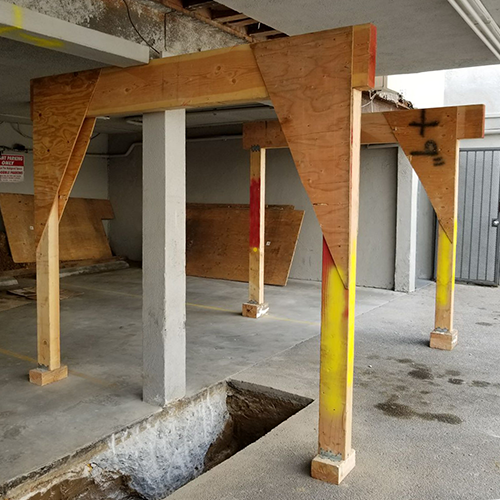
Soft Story Retrofit Shoring
The best time to protect your building is before the first shovel goes in.
Ask for the plans and the schedule. California's Civil Code §832 generally requires anyone excavating next to your property to give you notice before digging starts, including how deep they plan to go. Ask the contractor or developer for the shoring and excavation plans.
Get a pre-construction condition survey. An engineer documents your building's existing cracks, levels and condition with photos and measurements. If damage shows up later, you'll have a record of what was there before.
Ask about monitoring. For deep excavations, crack gauges or survey points on your building can catch movement early, before it becomes damage.
Check the permits. You can look up the project's permits and inspection history with the Los Angeles Department of Building and Safety (LADBS) or your city's building department.
Document as work goes on. Keep taking dated photos, and write down when heavy equipment or vibration is happening.
Act quickly on changes. Report new damage to the contractor in writing, and have an engineer assess it.
This isn't legal advice. If you have a dispute with a neighbor or developer, talk to a real estate attorney.
Why this matters in Los Angeles
Much of LA's housing was built decades before today's codes. That includes thousands of soft-story apartment buildings: wood-frame buildings with open parking or large windows on the ground floor and living space above.
In 2015, the City of Los Angeles passed Ordinance 183893, which requires retrofits of pre-1978 wood-frame soft-story buildings and non-ductile concrete buildings (LADBS). The ordinance was written with earthquakes in mind. But the same weaknesses, such as a weak first story or shallow, aging foundations, can make a building less able to tolerate movement from any source, including construction next door.
You can check whether your building is in the city's program on the LADBS mandatory retrofit page. Owners outside the city of LA should check with their own city, since several nearby cities have their own programs.
Talk to a structural engineer
If construction is about to start next to your property, you've noticed new cracks or settling, or you're not sure how your building would hold up, an assessment is the place to start. Omega Structural has served Los Angeles property owners since 2013 with:
Structural assessments and pre-construction condition surveys
Foundation repair
Soft-story seismic retrofits
Consultation on structural risk before you build or buy
Schedule a structural assessment → HERE or call us at (323)373-5964.
